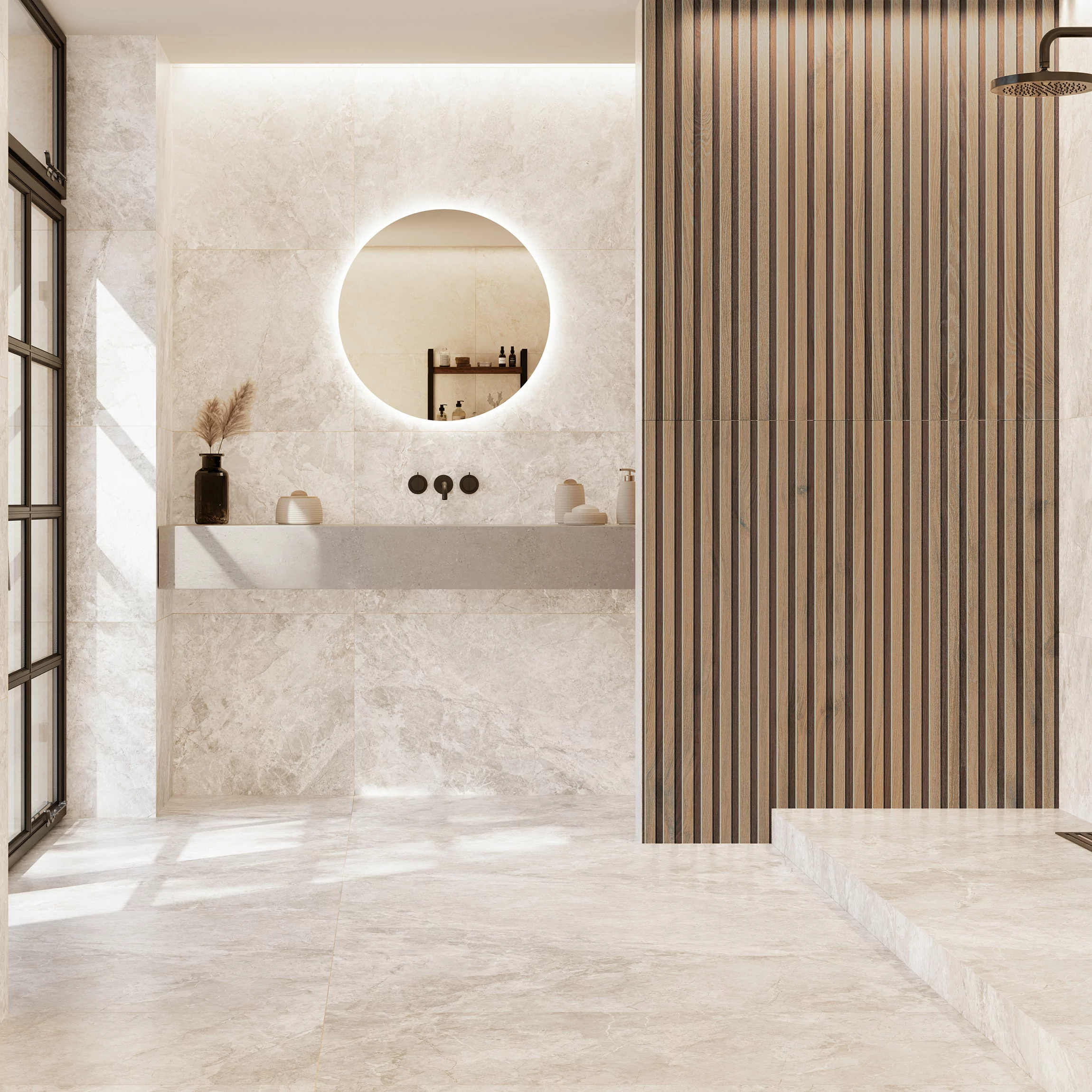
Large tiles can make a room feel calmer because fewer joints interrupt the surface. Large format tile ideas work especially well in contemporary bathrooms, open kitchens, entryways, and living spaces where a continuous material look matters.
Size alone doesn’t create the effect, though. Layout, substrate preparation, pattern variation, and edge placement determine whether the finished room feels refined or awkward.
Use Large Tiles to Reduce Visual Fragmentation
A floor covered with many small tiles naturally creates a visible grid. Larger pieces reduce that grid, letting the eye focus more on the material itself.
This idea can extend beyond interiors. Looking through broader patio planning inspiration can reinforce how larger paving or surface units often create a calmer foundation when surrounding architecture already contains plenty of detail.
Consider the Room Before Maximizing Tile Size
The largest available tile is not automatically the best choice. A small room with many corners, doorways, plumbing penetrations, or changes in floor level may require numerous awkward cuts.
Choose a format that fits the room’s dimensions sensibly. A slightly smaller large-format tile with clean cuts often looks better than oversized slabs broken into thin pieces around every edge.
Create a More Continuous Bathroom
Large-format porcelain is particularly effective in showers and bathroom floors because it reduces the number of visible grout joints. Using the same or related tile on walls and floors can make separate surfaces read as one coordinated envelope.
That continuity works with many modern home design ideas, especially when cabinetry and fixtures have simple forms.
| Surface | Format Strategy | Main Benefit |
|---|---|---|
| Shower wall | Tall rectangular tile | Fewer horizontal breaks |
| Bathroom floor | Large square tile | Calm visual field |
| Kitchen floor | Large rectangle | Connects open areas |
| Feature wall | Oversized slab look | Emphasizes material |
A restrained grout color strengthens this effect by keeping joint lines from becoming the dominant pattern.
Balance Big Surfaces With Warmer Details
Large expanses of stone-look or concrete-look tile can feel cold if every other surface is equally hard. Wood, woven fabrics, upholstered seating, warm lighting, and softer shapes prevent the room from becoming clinical.
Small decorating cues from relaxed interior styling can be useful here because texture matters more once the architectural surfaces become simpler.
Even a timber vanity or a linen curtain can change how a tiled room feels. You don’t need to add more pattern simply because the large tile is visually quiet.
Plan Veining and Pattern Before Tiling
Large marble-look tiles often contain dramatic veins that extend across much of the surface. Random placement can create abrupt changes, repeated markings, or lines that stop strangely at neighboring tiles.
Lay several pieces out before installation and rotate them until the movement feels balanced. Book-matched or continuous-vein effects require even more planning.
Natural variation also matters with stone. Two pieces from the same range can look noticeably different, so opening several boxes before work begins helps distribute tones more evenly.
Where Large Format Tile Causes Problems
Large tiles demand a flatter installation surface. Small irregularities that might disappear beneath small mosaics can cause oversized tiles to rock, sit unevenly, or create raised edges.
Waste is another overlooked issue. Complicated rooms may require large offcuts around cabinetry, corners, or fixtures. The cleanest-looking tile can therefore require more planning and material than its simple appearance suggests.
Frequently Asked Questions
What qualifies as large format tile?
Definitions vary, but the term generally refers to tiles noticeably larger than conventional small or medium formats. Manufacturers increasingly offer oversized rectangles, squares, and porcelain panels for both floors and walls.
Do large tiles make small rooms look bigger?
They can make a room feel less visually divided because there are fewer grout lines. The effect also depends on color, lighting, layout, furniture scale, and how many cut pieces appear around the perimeter.
Are large tiles harder to install?
They can be. Large pieces require careful handling, a properly prepared flat surface, suitable setting materials, and accurate alignment. Oversized panels may also need specialized tools or additional installers.
Plan the Surface as One Composition
Large format tile looks simple because much of the visual clutter disappears. Achieving that simplicity takes precise decisions before installation starts.
Study the room dimensions, expected cuts, pattern direction, and grout placement together. When those details are resolved early, fewer lines can genuinely make the finished space feel cleaner.